Serving the public as an Election Day poll worker was never on my short list of civic activities. It certainly never entered my mind when I first voted in 1988, or during hurried trips to my local fire station a.k.a. Polling place before I headed to work in the 90s. When my marriage turned my last name into a hyphenated one– and I became surprisingly difficult to locate on the voter rolls (It’s under “L,” not “B,” I’d advise them, every time, to no avail)-- I definitely had no desire to take on that particular duty. By the 2010s my quiet, introverted self had worked the desk at a homeless shelter, taken calls on a crisis hotline, cared for toddlers at my church daycare, and trained as a reading tutor. Becoming a poll worker, interacting openly with hundreds of people for hours on end? I just wasn’t feeling it.
But when Election Day 2016 opened my eyes to a side of America I was generally unaware of, I pushed out of my comfort zone and attended the local 2017 Women’s March with a friend. That led to my joining a small group that aimed to support like-minded locals running for office while also holding the state’s most conservative representatives accountable for their increasingly alarming actions. Which led me to canvassing, phone banking, postcard-writing, and other action verbs that helped me feel I was doing something besides letting my lifelong anxiety get the best of me.
Millions of other Americans did, too. And as Senate and House seats flipped in 2018, followed by Joe Biden’s presidential victory in 2020, I felt better about what I saw as the United States’ wake-up call being answered.
But then came the aftermath: voting centers falling under attack amid “Stop the steal” chants in swing states that were still tallying the results. Threats of physical harm to everyday people just doing their part for the democratic process (for little to no pay). And after all that came the real-time threat to our democracy on January 6, 2021. But like the Sandy Hook shootings of nearly a decade earlier, the definitive ENOUGH IS ENOUGH on the subject matter never came to pass.
Why would they ever take the job on again? I wondered about poll workers caught in the crossfire of the 2020 elections. But not long after that, I reconsidered my longstanding preference to steer clear of “the job”. Mind you, I don’t live in a swing state– and the election-day drama level here in Indiana is quite low. But they still needed people, right? And suppose the disdain for Agent Orange (as I’ve come to call him) grew to the point that he ran again and lost this state? How lovely it would be to know I’d directly assisted the ones who voted him out!
So here’s an account of my maiden voyage as a “blue” poll worker serving a very red state, told in three parts…
NOTE: These are merely notes and observations from my personal experience as a Democratic election clerk in the Fall of 2024.
ONBOARDING (Eventually…)
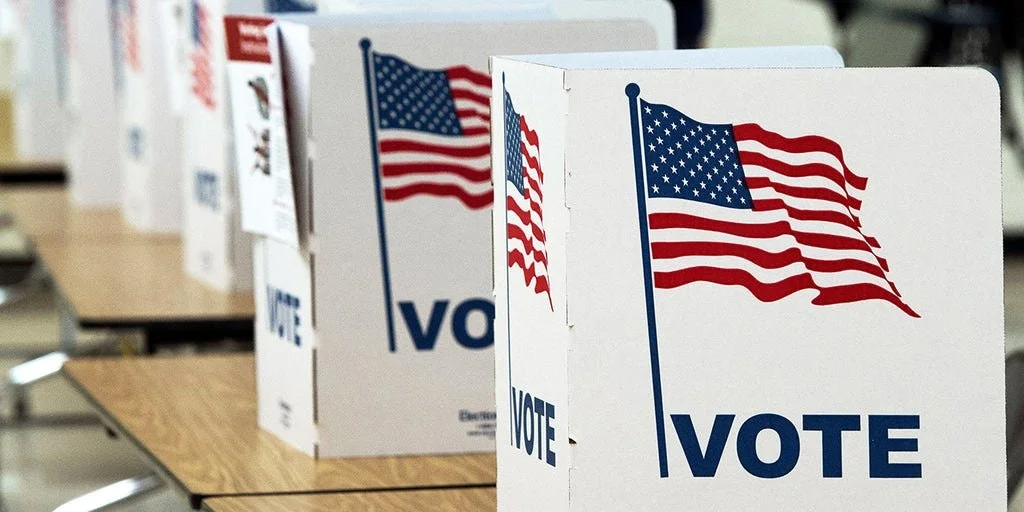
Getting started with simply BECOMING a poll worker was harder, in my opinion, than it should be. Over the summer I responded to a national online request for workers, filled out the basic info, and received a call a week later saying they were reviewing my info, and I could expect to hear more in September. But September arrived, and I heard nothing. When I tried to re-register, the system said it already has my SS# on file and that I needed to email a certain address for help. When I did, I heard from someone the next day, asking where I’d like to work on Election Day and how long (full or half day). But this person also said I needed to speak to someone else– we’ll call him Jeff-- before any of that could be confirmed.
It took another 11 days to get Jeff on the phone. While that conversation did solidify my plans for Election Day (and training, too, I thought), I still couldn’t get an answer on how to be scheduled to work early voting…and I also received no further confirmation about the training after that (nor could I get into the poll worker portal online). Only after my supervisor for Election Day itself (we’ll call her “Connie”) contacted me, by way of a text group for her workers, could I get the ball rolling again for answers. As I finally got into the online portal and locked down a training time, I continued to hear nothing from the people I’d been told I needed to talk with. It wasn’t until the conclusion of the training session that, by going out of my way to ask a few different people, I got the name and number of the early voting contact.
As desperate as my county claimed to be for early voting assistance– they’d even increased the hourly pay for it– you’d think there would be a less cumbersome way to recruit workers, right? And yet it was the day before my first shift when I spoke to someone and finally got assigned– not to my nearest location, but a township on the south side that needed me more.
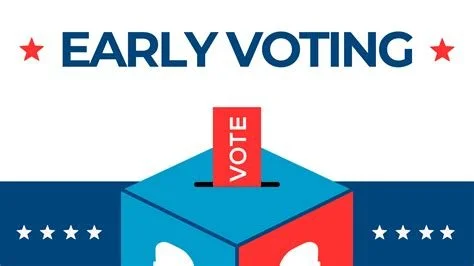
The Election Inspector for my Early Voting location– a place I worked two different days– initially put me to work “directing traffic” because our location’s setup was quite cramped, making the lines between the voting machines and the checkout line indistinguishable at times. Though I got the hang of it just fine, I was reassigned to the checkout line by 1 PM, as someone took a lunch break… and quickly learned how important the early-voting checkout process is.
In my state, two clerks have to 1) initial the ballot, which is then 2) placed in an envelope (ideally by the voter– the less the clerks physically handle a ballot, the better), 3) sealed with a glue stick, 4) signed by the voter and both clerks (names printed out too), then finally 5) placed in the nearby ballot box.
Aside from wishing my last name wasn’t hyphenated– writing the same 21 letters hundreds of times will do that– I spent the day making a wealth of observations:
Non-English-speaking voters had it rough if they did not bring with them an English-speaking friend or family member to assist. (The rules about what’s supposed to be provided on-site vary from state to state; I only know that my location had translators available sporadically, if at all.)
A tremendous number of voters didn’t read and/or listen to directions.
Some voters nearly dropped their ballot into the ballot box without an envelope (where it would NOT be counted) either because they were in a hurry, didn’t notice the row of voters waiting right in front of them, or both.
Some voters instinctively put their ballot in the envelope and sealed it before they formally checked out– a move that usually required our Election Inspector to be pulled away from wherever she was working to sign off on the re-opening of said envelope.
Fewer voters were upset about the long lines and wait times than I’d anticipated.
My second day of early voting work had me “directing traffic” again, except this time I did it for all 8+ hours… so I got the true sense of that particular task, along with everything that went along with it–
Reminding voters every five minutes NOT to put their ballot in the envelope (and/or seal it)
Explaining to voters why their “printed” ballot was blank, and walking them through the process a second time
Explaining how to vote a straight ticket
Explaining why one still had to go through the entire ballot and still make some choices, even if you were voting straight ticket
Explaining why one’s selections had to be verified before the ballot would print
Explaining why it looked like your screen was “freezing” (the verification process on the judges' portion is identical through each candidate)
“Shaking down” the actual ballot box near the end of the day so all the ballots would fit
As I said before, this was a fairly tight space where the voting took place– just ONE wheelchair-accessible station, and about 15 general stations (one of which broke early in the day and was never fixed). On the surface, the day felt rather lovely:
There were cheers with every “first-time voter” that was recognized
Voters were very polite for having waited two to three hours in line
Some voters wished each other well after meeting for the first time in line (Been nice talking to you/Good luck with everything/etc)
But as the proverbial “blue dot in a red state,” I felt compelled to absorb as much as possible, and pray it wasn’t just a business-as-usual election for these mostly conservative folks.
So here are the most memorable things I witnessed during the early voting…
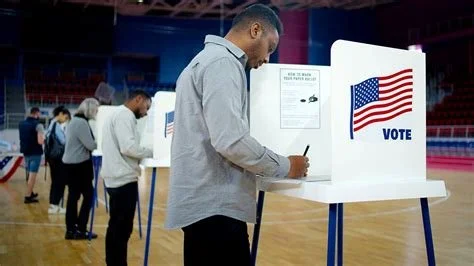
Disclaimer #1: Monitoring and assisting at today’s voter stations means you’re gonna see how people are voting. For me, it couldn’t be helped.
Disclaimer #2: While my personal ideologies informed my opinions here as much as they would anyone, my memories come from interactions with those voters who needed the most assistance. Nothing more, nothing less.
Countless numbers of Asian descent voters (probably Burmese, according to the demographics I reviewed later), who spoke little to no English, arrived five or six at a time— with one person doing most of the interpreting for all— and almost always voted straight Republican. Instinctually I longed to tell them BUT THEY DON’T EVEN WANT YOU HERE…DON’T YOU GET IT??? As the hours wore on, I came to wonder if they might have been advised by a superior at their place of work to vote Republican because layoffs might be imminent otherwise. Or perhaps some encountered the same social media post I’d seen from our state’s Gubernatorial candidate, warning people that their entire voting record was accessible to the public and “people would know” if you didn’t vote for key people? (Fun fact– that’s not how voting records work.)
Several Women Of A Certain Age came in unaccompanied, sought me out as soon as they got a machine to themselves, and said I’m dumb and/or I’ve never voted before… can you show me how to do this? And then voted Republican. (My instincts cried Who told you you were dumb? Is he here, so I can go up and punch him in the face?)
Meanwhile, other Women Of A Certain Age waited (or were asked by their spouse to wait?) until they could get a machine right alongside their husband, often letting him show them what to do or watching/imitating what they did… and voted Republican.
And in “voting Republican,” I should add that most of the voters I named above (as well as others who didn’t need as much assistance) spoke as if they were there SOLELY to vote for President– they didn’t care about public questions, or the races for Governor or Attorney General, and certainly not members of the school board or judicial retention.
This was the opposite of what I thought would happen— that people who’d never bothered to vote before showed up to keep the 45th POTUS from becoming the 47th as well.
And I couldn’t help but wonder… was this what was happening elsewhere…?!
Observations during Election Day
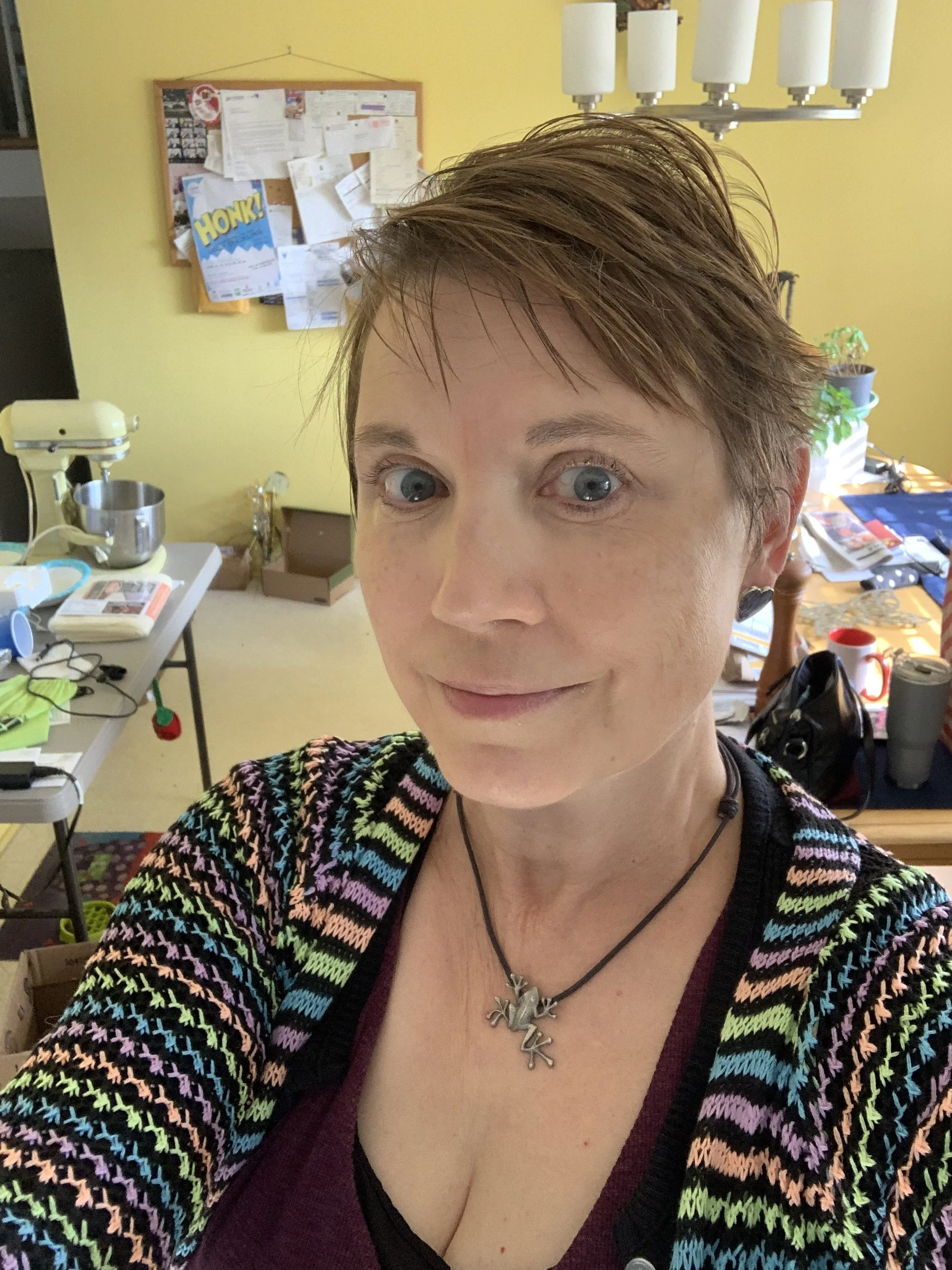
(That’s me that day, doing my best to look hopeful)
Sporting a rainbow-striped cardigan (my effort towards subtlety as a liberal), I worked around nine hours on 11/5/24 at a polling place much closer to home– also much larger, with better air circulation and a distinct, quiet line of citizens framing the perimeter. With the voter “traffic” practically directing itself, I felt a little unnecessary simply pointing out empty voter stations and answering basic questions. But they kept me busy enough with many of the same ballot-specific questions as I’d had at the other location. It was more of a racially mixed crowd of individuals this time around, with far fewer non-English speakers among them.
But aside from the gentleman who wrote in “Jesus” for every single candidate, and the woman who barely seemed to know what she was doing there but was simply excited to vote, the drama levels were low. Downright subdued, in fact. I wanted to continue feeling the cautious optimism I’d nursed ever since Kamala Harris was named to the ballot, but it was no longer coming naturally. Had just a few days of hanging around actual red-state voters tamed my spirit THAT much?
After the final vote of the day was cast at our location, we dismantled the machines, signage, and other necessities, and went about organizing the completed ballots so they’d be easy for our Election Inspector to transport to downtown Indy. About 20 minutes into this part, I noticed the ballot box (a much more sophisticated unit on Election Day than the vessel used in early voting) producing a long paper tape… the computerized counts from each race that day. I couldn’t resist taking a look. Though I didn’t take note of numbers (including how many voted there that day), Trump led Harris by something like 60 votes.
In a red state like mine, the closeness of the vote might’ve come as a surprise– or even a good omen to people like me– except that at that same polling location, the Democratic candidate for governor got considerably more votes than the Republican– a race eventually won by the Republican, quite handily.
With that kind of result, how could it be that Harris didn’t follow suit at this location? Was it because Harris was a black woman, and the Democratic gubernatorial candidate in question was a white woman?
Was it because some folks were simply voting for Trump and not caring, possibly not even voting, for other candidates… as I’d seen in my early voting assignments?
Was it because Independent voters chose not to vote for a Democratic president because of the economy, or the state of the Middle East, or immigration, and tied those issues to Harris because she was the current VP?
While every poll worker I encountered that day worked diligently until the job was done, counting and recounting ballots and so on… the vibe remained muted. It reminded me of my neighborhood, which had been mostly devoid of yard signs the 2024 election season. Some had quietly added Harris-Walz endorsements; a few others had maintained mini-MAGA altars throughout the Biden presidency. But the overwhelming majority kept their election cards close, refusing to show their hand early. Now, in the first of what I thought would be countless anxious hours of nationwide tallying, I worked among folks who were probably as divided in opinion as the country itself.
A cold, steady rain fell as we left that night. It only took about six minutes for me to get home, but in that time I still managed to hear on the radio that the governor’s race had already been called in favor of the Republican candidate. Our ballots didn’t even make it downtown yet! I hissed, as if I didn’t understand how a major Republican race here could be decided so damn quickly.
But all the layers muffling the majority also washed away with unexpected speed that night. What I’d witnessed at a local level was no anomaly. I went to bed as the swing states started stacking up, and awoke the next day attempting to console my 21-year-old daughter– who was of course even more aware, and more fearful, than the 13-year-old daughter I tried to console back in November 2016.
The days and weeks following the election prompted a spectrum of reasons for the outcome, of course. Some read like dissertations, others like one-liners in a sitcom. It all made about the same amount of sense to me.
The final plot twist in my pollworker’s tale came when I received my paycheck for two full days of work, plus half of Election Day, plus paid training… and it wasn’t even half of what I’d expected. Why? After more calls, more emails, and a lot more waiting, they determined it was because the Inspector at the Early Voting location had neglected to turn in the necessary paperwork. So there I was, sometime in January ‘25, hustling to get downtown in the middle of the workday so I could show proof of ID and get the process in motion already.
After 20 more minutes of explanations, phone calls to other departments, and waiting to hear back from said other departments… I finally felt somewhat confident that I’d get the rest of my pay in three to four weeks, as the woman behind the desk advised me. “We’ve got to make sure all our helpers get paid!” she said emphatically. “We need all of you to come back in a couple of years for the Midterms!”
If we’re still able to vote at that point, I thought… behind a tight smile.
Whether you read this to compare and contrast your own poll worker experience, out of sheer curiosity, or any other reason under the sun… thanks for doing so. Comments are welcome, as always!